The 1872–73 United States House of Representatives elections were held on various dates in various states between June 4, 1872, and April 7, 1873. Each state set its own date for its elections to the House of Representatives before the first session of the 43rd United States Congress convened on December 1, 1873. They coincided with the re-election of United States President Ulysses S. Grant. The congressional reapportionment based on the 1870 United States census increased the number of House seats to 292.
Grant's Republican Party increased its majority greatly, partly at the expense of the opposition Democratic Party and partly by adding 49 new seats to the House. The proindustry outlook of the Republicans appealed to many Northern voters, especially as the post-war economy exploded, and this allowed the party to flourish as the Industrial Revolution grew more widespread. The Republicans also benefited from a continuing association with victory in the American Civil War, as well as disarray amongst Democratic leadership.
Election summaries
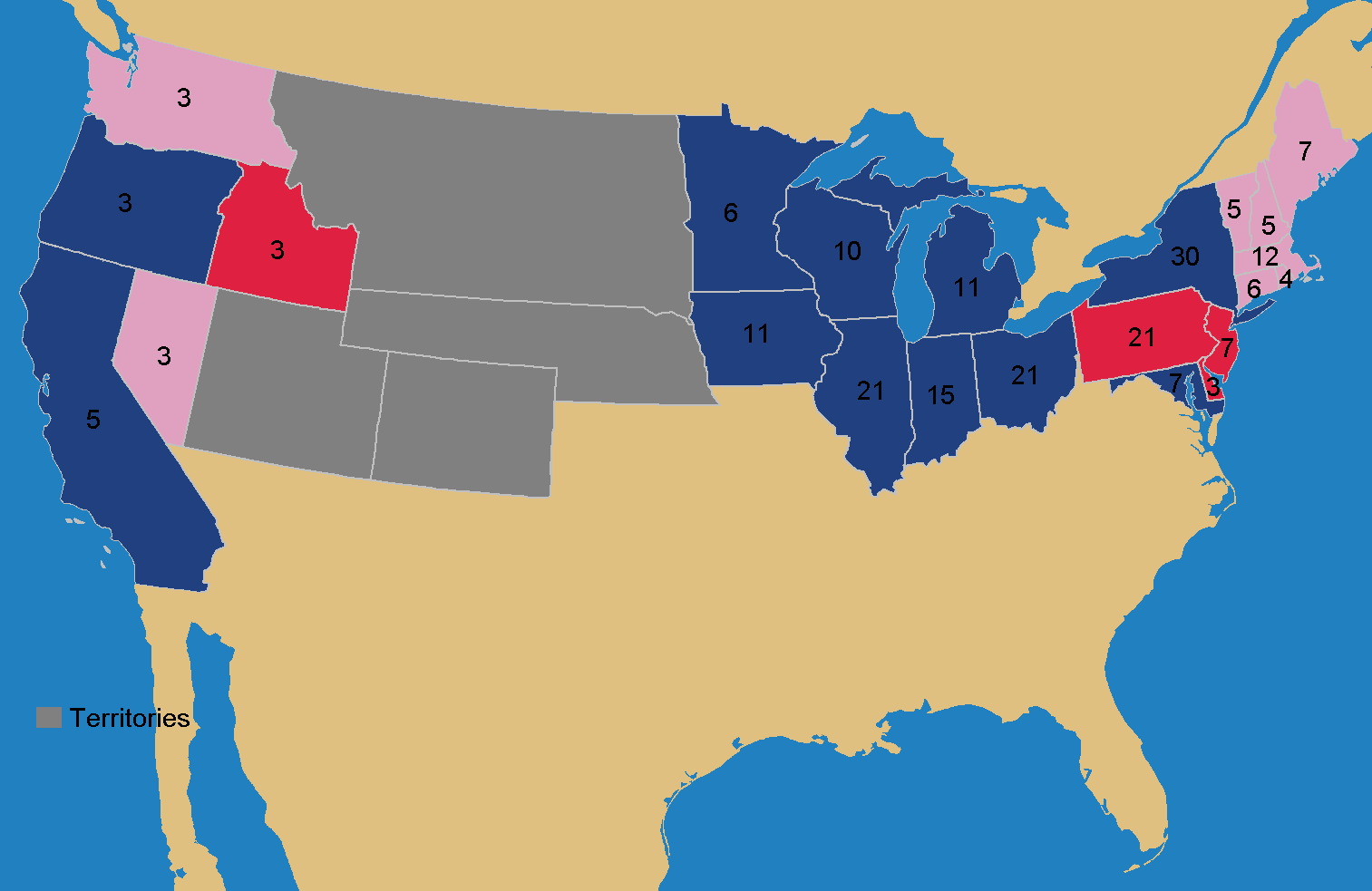
Following the 1870 census, the House was reapportioned, initially adding 40 seats, followed by a subsequent amendment to the apportionment act adding another seat to 9 states, resulting in a total increase of 49 seats. No states lost seats, 10 states had no change, 13 states gained 1 seat each, 9 states gained 2 seats, 3 states gained 3 seats, 1 state gained 4 seats, and 1 state gained 5 seats. Prior to the supplemental act, two states (New Hampshire and Vermont) had each lost 1 seat. This was the first reapportionment after the repeal of the three-fifths compromise by the 14th Amendment.
This would prove the last time until 1966 that a Republican won a House seat in Arkansas.
Election dates
In 1845, Congress passed a law providing for a uniform nationwide date for choosing Presidential electors. This law did not affect election dates for Congress, which remained within the jurisdiction of State governments, but over time, the States moved their Congressional elections to this date as well. In 1872–73, there were still 9 states with earlier election dates, and 2 states with later election dates:
- Early elections (1872):
- June 4 Oregon
- August 1 North Carolina
- August 27 West Virginia
- September 3 Vermont
- September 9 Maine
- October 8 Indiana, Nebraska, Ohio, Pennsylvania
- Late elections (1873):
- March 11, 1873 New Hampshire
- April 7, 1873 Connecticut
Special elections
- Georgia 8: 1873
- Louisiana 4: 1872
- Louisiana 4: 1873
- Massachusetts 3: 1873
- Oregon at-large: 1873
- Pennsylvania 13: 1872
Alabama
Arkansas
California
A new seat was added, following the 1870 U.S. census, bringing the delegation up from three to four Representatives.
Connecticut
Delaware
The election was held November 5, 1872.
Florida
Florida gained a second seat after the 1870 census, but delayed districting until 1874, electing both Representatives at-large for this election.
Georgia
Illinois
Indiana
Iowa
Kansas
Kentucky
Louisiana
In the newly formed at-large district, George A. Sheridan (Liberal Republican) beat P. B. S. Pinchback (Republican), the first black Governor of Louisiana. Pinchback challenged the election and it was settled in February 1875, in Sheridan's favor, only one month before the end of the Congress.
Maine
Maryland
Massachusetts
Michigan
Minnesota
Mississippi
Missouri
Nebraska
Nevada
The election was held November 5, 1872.
New Hampshire
Elections were held March 11, 1873, After the March 4th beginning of the term.
New Jersey
New York
North Carolina
Ohio
After redistricting and eleven retirements, only four of the nineteen incumbents were re-elected.
Oregon
Pennsylvania
Rhode Island
South Carolina
Tennessee
Texas
Vermont
Virginia
West Virginia
Wisconsin
Wisconsin elected eight members of congress on Election Day, November 5, 1872. Two seats were newly added in reapportionment after the 1870 census.
Non-voting delegates
See also
- 1872 United States elections
- 1872 United States presidential election
- 1872–73 United States Senate elections
- 42nd United States Congress
- 43rd United States Congress
Notes
References
Bibliography
- Dubin, Michael J. (March 1, 1998). United States Congressional Elections, 1788-1997: The Official Results of the Elections of the 1st Through 105th Congresses. McFarland and Company. ISBN 978-0786402830.
- Martis, Kenneth C. (January 1, 1989). The Historical Atlas of Political Parties in the United States Congress, 1789-1989. Macmillan Publishing Company. ISBN 978-0029201701.
- Moore, John L., ed. (1994). Congressional Quarterly's Guide to U.S. Elections (Third ed.). Congressional Quarterly Inc. ISBN 978-0871879967.
- "Party Divisions of the House of Representatives 1789–Present". Office of the Historian, House of United States House of Representatives. Retrieved January 21, 2015.
External links
- Office of the Historian (Office of Art & Archives, Office of the Clerk, U.S. House of Representatives)
.svg)